
STORY YOUMISSED




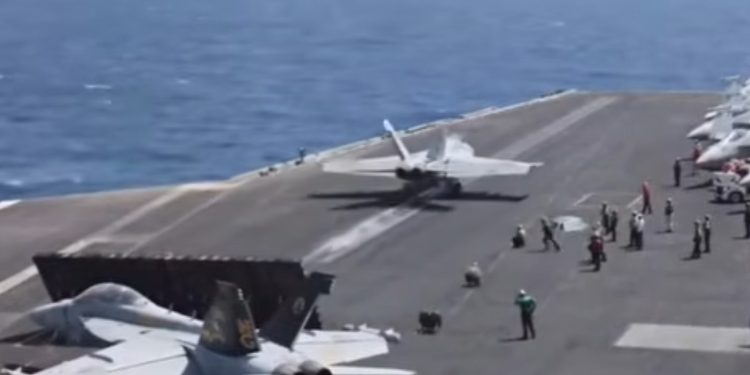
A U.S. Army Apache attack helicopter crashed near the strategic Strait of Hormuz waterway on Tuesday morning.
The New York Times first reported that the military aircraft went down under entirely unclear circumstances.
President Donald Trump acknowledged the crash and confirmed that the two crew members on board survived the incident.
Speaking to journalists at John F. Kennedy International Airport in New York after watching the NBA Finals on Monday night, Trump stated that the pilots are fine and nobody was injured.
The federal government plans to issue an official report regarding the incident on Wednesday.
The strategic waterway where the crash occurred remains under a tight chokehold by Iran.
The exact cause of the crash remains unknown as the Middle East reels from a major escalation where Iran and Israel exchanged fire the previous day.
That recent military exchange delivered the biggest blow yet to the straining ceasefire in the ongoing Iran war.
Iranian state media relied strictly on foreign reporting to acknowledge the helicopter crash without elaborating on the details.
The war has severely shaken the global economy, driven up energy prices worldwide, and made basic necessities like food more expensive since the U.S. and Israel began striking Iran on February 28.
International officials have been unable to turn the April ceasefire into a deal to permanently end the deadly conflict.
The U.S. military’s Central Command and the Defense Department did not immediately respond to requests for comment regarding the downing of the aircraft.
Apache helicopters serve as a key asset for the American military as it enforces a strict blockade on Iranian crude oil shipments and tankers to pressure Tehran.
The United Arab Emirates has also utilized these specific helicopters to shoot down Iranian drones during the war.
Despite the crash, Trump insisted that an American peace deal with Iran is actively coming.
The president expressed renewed optimism over negotiations, stating that the U.S. has a good chance of signing a deal in two or three days.
Trump did not provide any specific details to journalists on why there was reason for this new optimism.
The president stated that the administration is very close to having a very good, strong, and powerful deal.
Trump warned that if the U.S. chooses to bomb Iran for another two or three weeks, the country will have nothing left whatsoever.
The president added that a renewed bombing campaign would completely close the vital shipping lanes for months.
Trump explicitly rejected an extended bombing campaign, stating that a lot of people would be killed and he does not want to do that.
International mediators led predominantly by Pakistan have been trying for weeks to get a final agreement across the line.
Both Iran and the U.S. have taken hard-line positions that continue to stall the diplomatic talks.
The U.S. demands that Iran completely give up its stockpile of highly enriched uranium, which remains entombed in the country after American airstrikes in the 12-day war in 2025.
Iran is completely refusing that demand and is instead demanding immediate relief from economic sanctions.
Iranian negotiators also want the immediate release of frozen assets before a final agreement is in place, which is a condition that Trump has rejected.